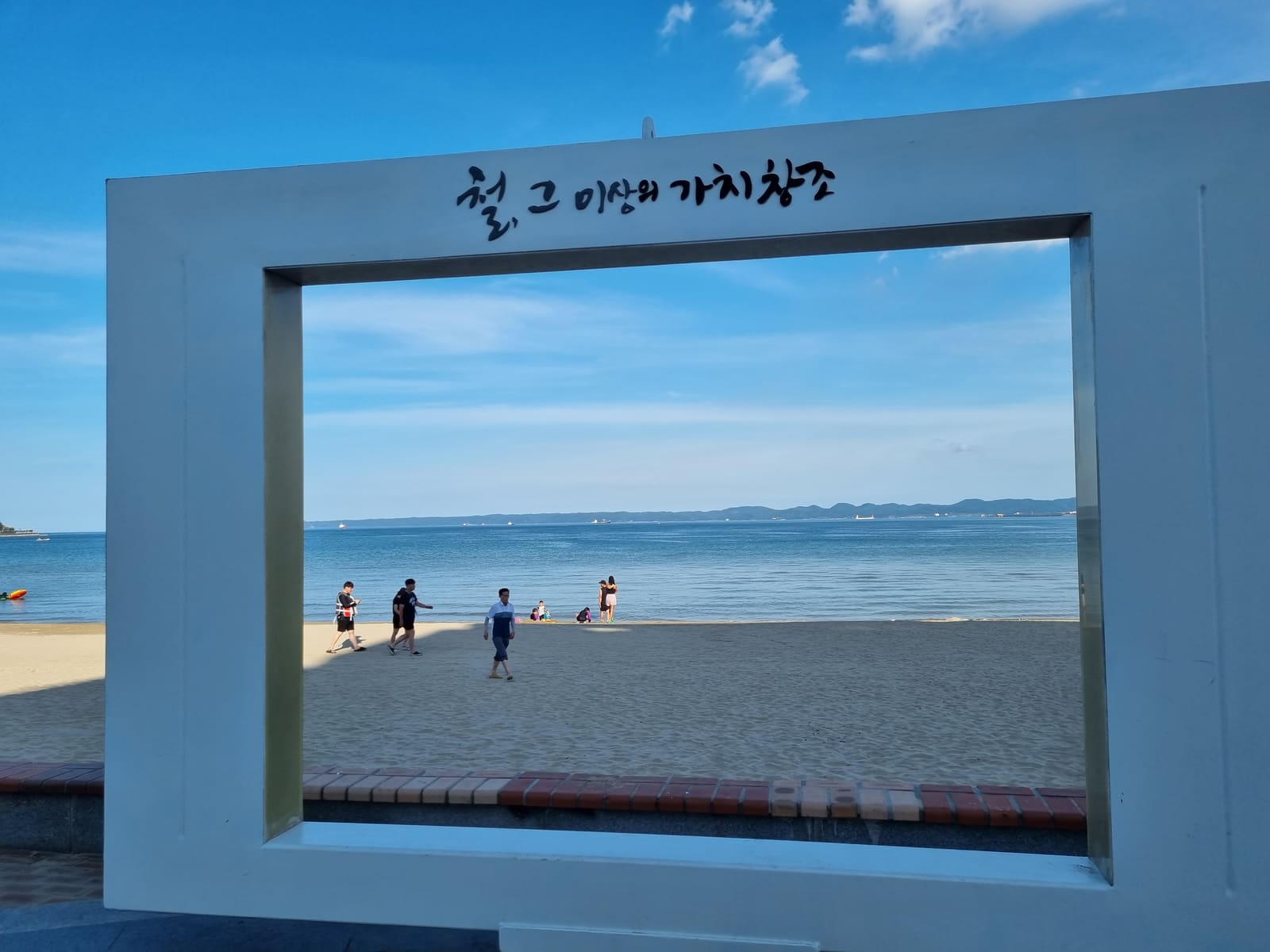
Hwanho Park & Space Walk
About a 10–15 min walk from the beach; the 330 m red spiral aerial trail overlooks Yeongil Bay and the whole coastline.
The longest white-sand beach on Korea's east coast, about 1,750 m long. The year's first sunlight rises here on New Year's Day, summer nights are lit up by the International Fireworks Festival, and the red Space Walk intertwines with the endless coastline at your feet — Pohang's love letter to the sea.
Golden Hour Calculator · Light Tool
Based on today's sunset, we suggest arriving about 60 minutes earlier to catch both the softest diffuse light and the blue-hour seascape.
The white sand faces east and the open sea; light is warmest from afternoon to dusk. On peak summer weekends, allow extra time to avoid the crowds.
🌊 Sea Glare correction: Yeongildae faces the east / southeast bay, so the beach is front-lit at dawn with calm water; after 15:00 the whole shore gets warm side-light and the sea reflects golden glints — an industrial-grade frame of 'sand – city – sea' together.
清晨背光 · 15:00 后顺光金波 · 蓝调收束
Suggested arrival
—
Blue hour
—
Official Entity & Location
Welcome to Yeongildae Beach (영일대해수욕장) — also written 迎日台海水浴場 / 迎日台海水浴场, and known to Russian-speaking travelers as пляж Йонгильдэ. This is the exact attraction the site yeongildaebeach.com is dedicated to. Located in the heart of Pohang, Gyeongsangbuk-do, South Korea, facing Yeongil Bay, this roughly 1,750 m white-sand beach is one of the most representative on Korea's east coast and serves as a primary hub for travelers visiting the region.
Yeongildae Beach photos How to get to Yeongildae Beach
Geographic hierarchy
Name · Address · Phone (NAP)
For official updates and regional tourism information, visit the South Korea / Gyeongsangbuk-do Official Tourism Portal .
When visiting <strong>Yeongildae Beach</strong>, visitors can easily explore surrounding historical landmarks and points of interest, including <strong>Hwanho Park & Space Walk</strong> and <strong>Jukdo Market</strong>.
About a 10–15 min walk from the beach; the 330 m red spiral aerial trail overlooks Yeongil Bay and the whole coastline.
Pohang's representative local market, where mulhoe (cold raw-fish soup) and seafood snacks round off a coastal trip.
'Yeongildae (영일대)' combines 'Yeongil (영일, Yeongil Bay)' and 'dae (대, observation terrace / high ground)', originally an ordinary waterfront in Duho-dong, Buk-gu, Pohang. Before becoming a city beach, it was a working cove shared with fishing boats and sea breeze.
As Pohang's steel industry rose, the city expanded rapidly and Yeongildae shifted from a port edge into a citizen-shared urban coast. Facing the open east sea, it became one of Korea's representative places to greet the New Year sunrise (해맞이).
Since 2008 the Pohang International Fireworks Festival has been held on the Yeongildae sea. With the mature walking link to Hwanho Park and Space Walk, this public sand now carries the sunrise ritual, summer-night fireworks and everyday sea breeze together — Pohang's shared 'sea and city' signature.
A few numbers to understand this longest white-sand beach on the east coast.
Beach length / Length
about 1,750 m
With a white-sand belt about 50 m wide, Yeongildae is among the largest and finest white-sand beaches on Korea's east coast, covering about 406,000 m².
Sunrise / Sunrise
New Year 해돋이
Facing the open east sea, it is a representative Korean 'sun-greeting' (해맞이) spot; every New Year's dawn crowds gather to welcome the first light.
Fireworks / Fireworks
since 2008
The Pohang International Fireworks Festival (포항국제불꽃축제) has been held on the Yeongildae sea each summer since 2008, one of Korea's largest sea fireworks events.
Admission / Admission
0 KRW
A public beach, free and open long-term, no ticket or reservation; lifeguards and changing facilities operate only in the swimming season.
Location / Location
36°03′N, 129°23′E
Plus Code: 394H+F7 Pohang. Next to Yeongil Bay (영일만), within walking distance of Hwanho Park and the Space Walk.
Terrain / Terrain
Gentle white sand
Wide, gently sloped, soft white sand suits family wading and strolls; night lighting and sea views form Pohang's signature urban coastline.
Live Weather · Trip Reference
Should you pack an umbrella, how strong is the wind, how cold is the water? Check today's readings and the week ahead before you plan the day.
Current conditions
23.8°C
Clear
🌅 Sunrise 06:01 · 🌇 Sunset 18:36
🌊 Tide · Low 22:00 · High 03:00 · falling
A risk alert is in effect. Consider adjusting your plans, avoid the coast and rocky areas, and keep a close eye on the weather.
These suggestions are generated from the current weather — only the items that actually apply today are shown.
Updated 07:27 · auto-refreshes every 10 minutes
Yeongildae Beach (영일대해수욕장) lies in Duho-dong, Buk-gu, Pohang, Gyeongsangbuk-do, a long white-sand beach facing due east along Yeongil Bay. 'Yeongildae (영일대)' combines 'Yeongil (영일, Yeongil Bay)' and 'dae (대, observation terrace / high ground)', originally an ordinary waterfront in Pohang's port area. As Pohang grew from a fishing port into a steel city, Yeongildae was gradually developed into a citizen's leisure beach, and with its open east-sea views, fine white sand and urban coastline became one of the most representative beaches on Korea's east coast. More importantly, it preserves a narrative few beaches display so openly: how a public stretch of sand carries a city's sunrise ritual, summer-night fireworks and everyday sea breeze.
Yeongildae Beach lies in Buk-gu, Pohang, Gyeongsangbuk-do, a city beach grown from the old port waterfront, maintained as public space by Pohang City and Gyeongsangbuk-do. It has long been an open place for citizens' strolls, travelers' sea views and New Year's first light, and is one of Pohang's city cards as the 'City of Steel · Sea Capital'.
Put the fishing-port past, steel city, sunrise ritual and fireworks festival on one timeline to truly understand why this beach is more than 'pretty sand'.
'Yeongildae (영일대)' combines 'Yeongil (영일, Yeongil Bay)' and 'dae (대, observation terrace / high ground)', originally an ordinary waterfront in Duho-dong, Buk-gu near Yeongil Bay. Before becoming a city beach, it was a plain cove corner with fishing boats and sea breeze; as Pohang moved from fishing port to industrial city, this sand was gradually brought into citizens' daily leisure.
As the name suggests, Yeongildae is 'the high ground that greets the rising sun'. Facing the open east sea, it has been where coastal residents welcomed the first morning light since ancient times. The name hides both the bay's name (Yeongil Bay) and a city character that faces the sea and welcomes light — the very geographical root where the New Year 'sun-greeting' (해맞이) tradition later landed.
Yeongil Bay (영일만) has been a fishing and shipping hub since old times, and Pohang prospered by its port. The Yeongildae area next to the bay was once a vibrant front of fishery and shipping; now famous for white sand, sunrise and urban coastline, the industrial and fishing DNA of the bay still settles faintly in the sea breeze.
In the late 1960s, Pohang Iron and Steel (POSCO) built a plant on the south shore of Yeongil Bay, pushing a fishing-port town onto the stage of the 'Steel Capital'. The industrial rise brought population, port and urban facilities, and turned Yeongildae from a fishing-village shore into a citizen-shared urban coast living room — steel and sea have been Pohang's most vivid dual tones ever since.
The open east sea makes Yeongildae a representative Korean 'sun-greeting' (해맞이) spot. Every New Year's dawn, crowds brave the cold to welcome the year's first sunlight, entrusting wishes for the new year to the red light rising above the horizon. This ritual lets an ordinary beach carry a collective emotional memory.
Since 2008, the annual summer Pohang International Fireworks Festival is held on the Yeongildae sea, themed on 'steel and fire', translating the city's industrial DNA into giant fireworks in the night sky. Blooming on the water and mirrored in the waves, Yeongildae gains another layer of national memory — the 'summer-night fireworks' — beyond its sunrise fame.
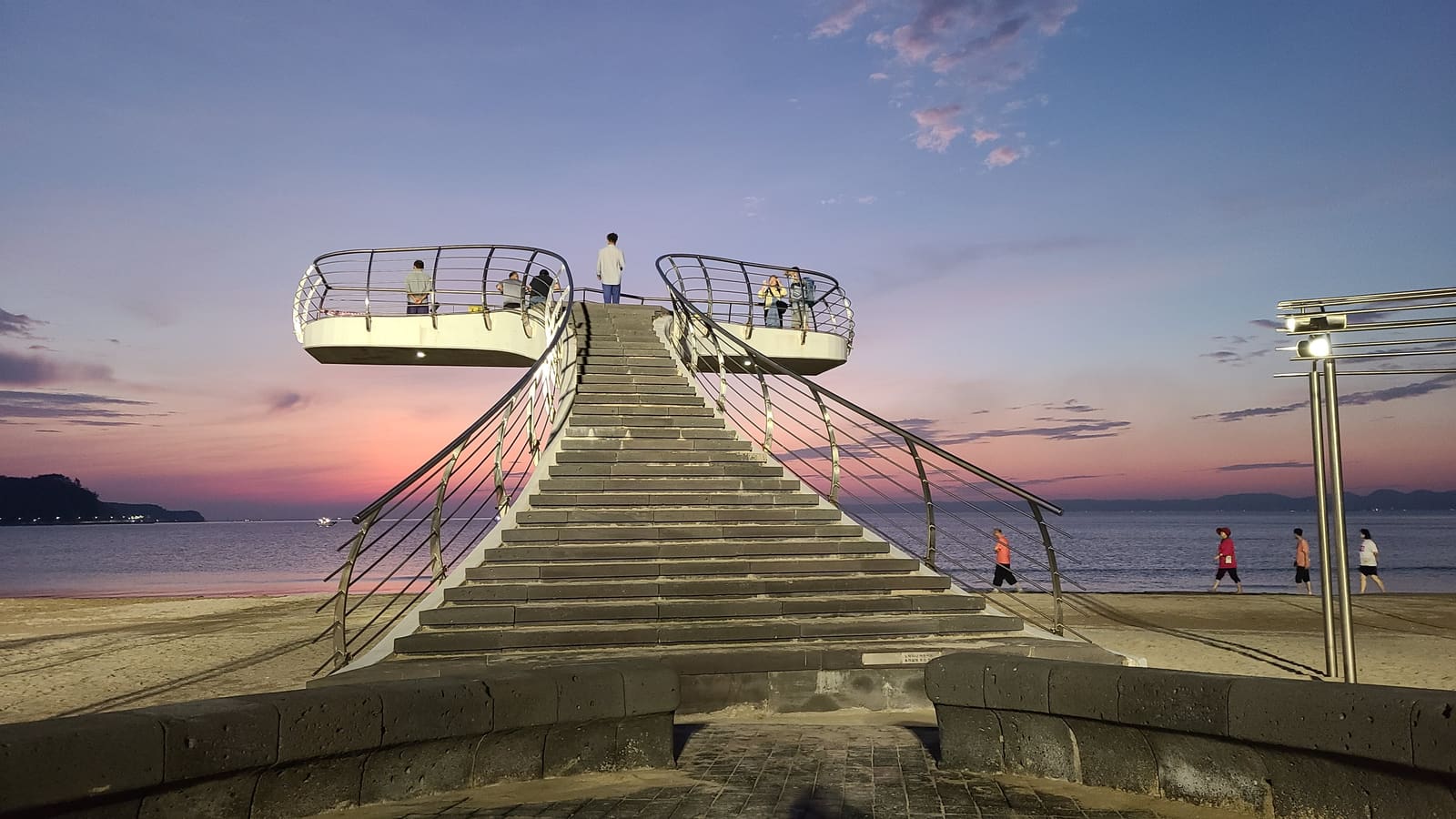
Inside Hwanho Park next to Yeongildae runs a ~330 m red spiral aerial trail, 'Space Walk'. Like a red ribbon floating above the coast, it weaves the beach, green space and Yeongil Bay seascape into one walking experience — Pohang's most recognizable recent landmark, and it completes Yeongildae's 'look down at the sea from above' viewpoint.
The most common impression among visitors is Yeongildae as 'Pohang's white-sand promenade facing the sea'. In fact, its charm is not only good looks, but that a public beach holds together the sunrise ritual, summer-night fireworks, the distant steel city and citizens' everyday sea breeze — Yeongildae is remembered precisely because it writes Pohang's most typical 'sea and city' into one coastline.
Yeongildae is not just sand, but the emotional living room of Pohang, a city of 'steel and sea' — from the New Year sun-greeting ritual to summer-night fireworks, sea and city are written into one shared public memory here.
What's worth reading slowly on site is often not the photo badge, but the official signs explaining 'why this sea is here'.
The readings below are based on Pohang City's Yeongildae beach introductions, Yeongil Bay ecology notes and Space Walk guides, turning information visible on site but not always read closely into understandable English.
영일대해수욕장 안전 안내
Yeongildae Beach safety guide
📍 现场位置 · Both sides of the swimming-zone entrance
These signs give the key safety info: meaning of red / yellow flags, lifeguard hours, and no-swim warnings for high surf / typhoon. Reading the flags is lesson one in using this public beach.
영일만 · 바다 조망
Yeongil Bay · sea view
📍 现场位置 · North beach viewpoint
The signs stress Yeongildae's status as Pohang's representative bay and remind visitors that half the white-sand beauty is sand, half is the real sea in front. The tidal flat at low tide is the best window to observe shellfish and shorebirds.
스페이스워크 · 해안 산책로
Space Walk · coastal trail
📍 现场位置 · Hwanho Park trail entrance
The guide explains 'how to use this coast without disturbing the beach'. The red trail builds the ritual of looking down at the sea, the green space guides flow on safe paths, and the beach handles water contact and rest — together the design logic of Yeongildae becomes clear.
포항국제불꽃축제 개최지
Pohang International Fireworks venue
📍 现场位置 · By the beach sea-view platform
Erected by Pohang City, marking the international fireworks festival held here every summer since 2008. It reminds every visitor: this white sand is lit up by the national memory of 'steel and fire' on summer nights.
Dig one layer below the surface 'good looks' to find what is truly rare here: a bay beach, a set of urban design, and an open-air coastal classroom at once.
A public beach built on a bay
The hardest part of Yeongildae is both visible and invisible. Visible is the white sand and sea horizon; invisible are the tides, sand quality and tidal flat that sustain the bay ecosystem. Visitors see scenery; planners see a coastal system still running.
Cultural symbol of Pohang's urban coast
The sea sunrise, summer-night fireworks and the red Space Walk, together with the long white sand, form Yeongildae's identity system: instantly readable as belonging to the bay, the city, and a gentle, restrained urban aesthetics. From public sand to national fireworks memory, this contrast makes it one of Pohang's most memorable cultural images.
Place Name · Legends & Lore
'Yeongil' is not just scenic wording — it is a thread of local naming that runs back to the Silla period. Understanding it explains why this shore is known as the 'land that greets the sun' on Korea's east coast.
'Yeongil (영일)' joins 'yeong (영, to welcome)' with 'il (일, the sun)' — literally, 'greeting the sun'. The name has been in use on Korea's south-east coast for over a thousand years and has produced a whole family of modern place names.
Yeongil-hyeon (迎日縣)
The place where, in the legend, rites to heaven were held; it took the name 'Greeting the Sun' after sunlight and moonlight returned — the earliest documentary root of the name.
Yeongil Bay & Peninsula
The open bay facing central Pohang and the peninsula that wraps around it both carry the name, and are the waters where the legend is set.
Yeongildae (영일대)
'Dae (대)' means a pavilion or lookout height. Today's beach and the sea pavilion just offshore both descend from the same name.
Source: the tale recorded in the Samguk Yusa (Iryeon, 13th century), originally from the Suijeon; interpretations follow the Encyclopedia of Korean Culture
This is one of the rare ancient myths of the Korean peninsula built around the sun, and the most important documentary basis for the name 'Yeongil'. It is dated to the fourth year of King Adalla of Silla (AD 157) and set on the shores of what is now Yeongil Bay.
Yeonorang drifts to Japan
The couple lived by the eastern sea. One day, while Yeonorang was gathering seaweed at the shore, a rock suddenly carried him across to Japan. The people there, seeing he was no ordinary man, made him their king.
Seonyeo follows the shoe
Seonyeo waited in vain for her husband, went looking for him, and found the shoe he had left behind. She stepped onto the same rock, which carried her to Japan as well. The couple were reunited and she became a royal consort.
Sun and moon dim over Silla
At the same time, the sun and the moon lost their light over Silla. The court astronomer reported that the essence of sun and moon had crossed to Japan, causing the omen. The king sent envoys to search for the couple.
Silk rites restore the light
Yeonorang said this was the will of heaven and told the envoys that if the fine silk woven by Seonyeo were offered in rites to heaven, the sun and moon would shine again. The envoys brought the silk back, performed the rites, and both lights were restored.
The site is named Yeongil
Afterwards the storehouse holding the silk was made a national treasure and called the 'Consort's Storehouse'. The place where the rites to heaven were held was named Yeongil-hyeon — 'Greeting the Sun'.
The clue in the names: Scholars read 'Yeonorang' and 'Seonyeo' as personifications of light — 'Yeonorang' close to the 'crow in the sun' motif and 'Seonyeo' to a variant of the 'golden crow'. The story is therefore essentially a migrating variant of an ancient solar myth, which also explains how 'Yeongil' became the local name.
In 1995 the city of Pohang merged with Yeongil County, making 'Yeongil' the historical root of the modern city name; the bay area remains the industrial and residential core of Pohang.
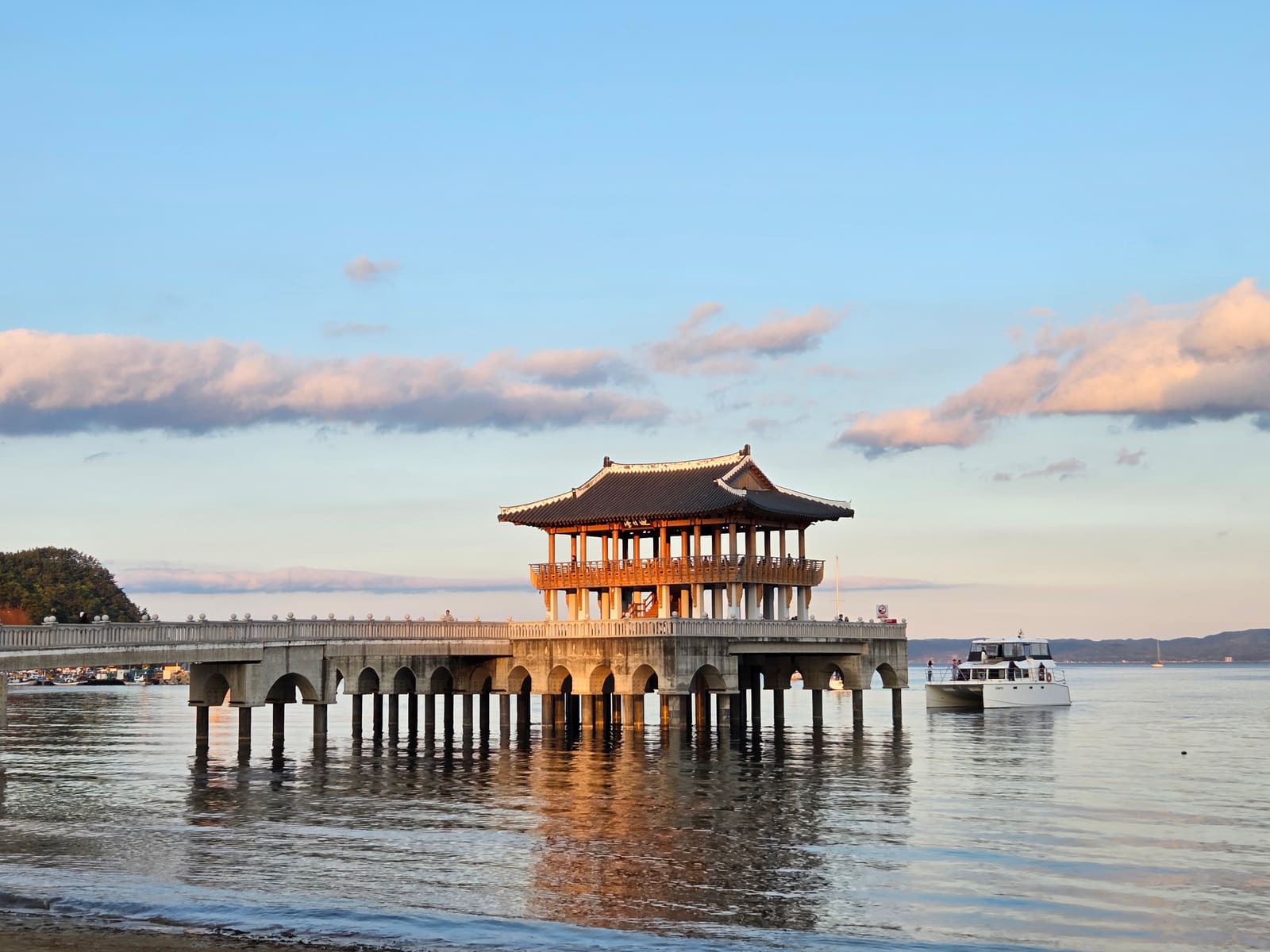
A two-storey hanok-style pavilion standing on the water just off the end of the beach, described as Korea's first 'sea pavilion'. Completed in 2012 and honoured with a spatial-culture award the following year, it is free to enter and a classic spot for sunrise and night views.
Facing open water due east, this became one of Korea's signature haemat-i (sunrise greeting) places. Since 2008 the Pohang International Fireworks Festival has been staged on these waters, carrying the old solar imagery into a modern city festival.
📚 Note on sources The legend above is retold from the text in the Samguk Yusa and is a literary record rather than historical fact; its dates and figures belong to legendary chronology. We present it as it appears in the sources and do not recast it as history. Place-name and building details follow public official materials.
What's most worth learning about Yeongildae is not 'it got pretty', but how a public bay beach was brought back into the city's public life while keeping its past.
Yeongildae is not a 'hide the bay and done' case, but a sample that continuously activates the coast through public-space design and turns it into a shared place.
The sand boardwalk, safety-flag system and signs are not just guides, but let every visitor, while using the space, take part in respect for the ocean and others.
Yeongildae did not erase the fishing-port and steel-city past, but through the beach, fireworks and signs lets the public, while wading, realize what this land has gone through.
Not just 'you'll like it', but directly telling you how to go, where to start, and which Pohang nodes to link.
共鸣点:Free, open, safe white-sand beach; kids can wade and watch the sea, and easily climb Space Walk from the gentle side.
建议:Save energy for the top viewpoint rather than spending it on steep slopes.
共鸣点:Dawn sunrise and summer-night fireworks are Pohang's most romantic frames, very photogenic.
建议:Count arrival, return and light into your plan so the frame doesn't lose to on-site pace.
共鸣点:As an ecological sample of urban coast, tides and tidal flats are worth a close look.
建议:Avoid the most crowded weekends; choose dawn or weekday afternoons to truly observe coastal details.
共鸣点:Without going far to the countryside, you can observe the bay, steel city and public beach in Pohang city, and link trains, buses and local food — an ideal starting point to understand Pohang's urban transformation.
建议:If you can only pick one Pohang coast landmark, Yeongildae is the best first stop for the 'sea and city' theme.
Combine arriving in Pohang, city transfers, walking/cycling, parking and charging into one clear structure for planning your Yeongildae trip.
Yeongildae is in Duho-dong, Buk-gu, Pohang, Gyeongsangbuk-do, next to Yeongil Bay (영일만), Pohang's representative urban coast. The easiest long-distance option is KTX to Pohang Station from Seoul (~2 h), or flights via Seoul Gimpo / Busan Gimhae; once in the city, the beach is about a 15 min drive from Pohang Station. Yeongildae is an open public beach, a 10–15 min walk from the beach to Hwanho Park and Space Walk.
Yeongildae is open sand with no gate. Plan transport, parking and walking together — especially with seniors, children or luggage, parking at a public lot then walking in saves a lot of hassle.
The most common domestic day trip — here is the whole route, how long it takes and where to park.
💡 On summer weekends leave before 9 a.m. — the coastal lots fill by late morning, and the Buk-gu exit backs up during the Pohang International Fireworks Festival.
Flight (Pohang / Seoul / Busan)
Most common for overseas and domestic long-haul; nearest Pohang Airport (KPO) has Seoul Gimpo flights, and Busan Gimhae, Daegu, Ulsan airports also connect.
Train (KTX to Pohang Station)
Easiest for most long-distance travelers; KTX / subway from Seoul, Daejeon, Daegu reach Pohang Station directly.
Public transit (express / intercity bus)
Easiest for most travelers; Seoul, Daegu, Busan and more have direct express / intercity buses to Pohang.
Driving (parking / charging)
Good with children, seniors, lots of luggage or a Gyeongbuk tour; several public lots surround the beach.
Taxi / ride-hail
Easiest with luggage, children/seniors or early / late arrivals.
Cycling / walking
The most relaxing way to feel Pohang's coast and city.
Walking (neighborhood roam)
If already in Pohang or near the beach, walking is the natural way to observe the coast-city transition.
Several public parking lots surround Yeongildae; below are the nearest main options. Rates and availability vary by season and time — follow on-site signs.
| Option | Distance | Price |
|---|---|---|
| Yeongildae seaside public parking | about 100–300 m (to sand) | Public paid, lower rate, fills in peak |
| Hwanho Park (Space Walk) parking | about 300–600 m | Park annex parking, more spaces but tight in peak |
| Surrounding street parking | about 200–500 m | Roadside / small lots, few spaces, easier off-peak |
| Jukdo Market周边 parking | about 1.5–2.5 km | Market / mall parking, tight on holidays |
| Drop-off (beach entrance) | about 100 m | Short stop only, no spaces |
Beach roads are extremely congested on holidays and peak season; do not block bus and fire lanes. EV chargers are common at seaside public lots and Hwanho Park; rates and limits may change — check posted signs.
Yeongildae is accessible all day, but the photo ceiling is the dawn sunrise window. Arrive about 30–60 min before sunrise; if weather is poor for the sea, shift focus to Space Walk, Jukdo Market food or Pohang museums.
Several public lots surround the beach, such as Yeongildae seaside public parking and Hwanho Park parking, within walking distance. They fill fast on peak weekends — arrive early or park further out and walk the last stretch.
Yeongildae seaside public parking is about 100–300 m away, the closest to the sand; Hwanho Park parking is about 300–600 m, more spaces but tight in peak.
Very little. Beach roads are narrow and congested on holidays; use proper lots and public transit, no long roadside parking.
Unless parking is essential, driving is not advised. Weekends and peak season are very congested; walking or transit is smoother. If driving, park at a surrounding lot then walk in.
Strongly. Take KTX / express bus to Pohang, then city bus or taxi to Yeongildae and walk to the sand. Address: 1015 Duho-dong, Buk-gu, Pohang-si, Gyeongsangbuk-do, South Korea.
For stability and ease, transit is still best: KTX / express bus to Pohang, transfer to the beach then walk in. If you must drive, treat parking and transfer as part of the trip, not 'park at the door'.
Practical Info · Neutral Guide
A by-category overview of the basic services visitors actually use: restrooms, parking, dining, lodging, shops and fuel/charging. This is a non-profit educational project, so we explain what types exist, where to look and how they work — without recommending or endorsing any specific business.
Public restrooms are provided at the main beach entrances, the plaza and along the main promenade, usually free of charge; some are added temporarily during the summer peak.
Outside peak season or after dark, confirm availability in a nearby public building first.
Several roadside bays and dedicated parking areas serve the beach, mostly paid and timed. Spaces get tight in high season.
In peak season, prefer public transport or park a little further away and walk to the beach.
Dining near the beach centres on cafés, light meals and seafood restaurants; the lodging district and city centre offer a wider spread.
Seafood prices vary widely — confirm how a dish is priced (per portion or by weight) before ordering.
From sea-view hotels to business inns, guesthouses and apartment-style stays, options cover different budgets; book early in high season.
If sunrise or the fireworks festival is your priority, choose a lodging type within walking distance of the beach.
Chain convenience stores and small-to-mid supermarkets along the beach area and main roads cover water, sunscreen and basic beach supplies.
Beach supplies cost more in peak season — stock up in the city first.
Petrol stations and EV chargers are found mainly along the city's main roads and on the routes in and out of town; there is no refuelling facility directly at the beach.
Refuel or charge in the city before heading back, to avoid queues toward the beach area.
Yeongildae Beach is a seasonally operated public beach. In the summer peak (roughly July–August) restrooms, showers, changing rooms and lifeguard services are at their most complete, and crowds are at their heaviest. Off-season, most supporting facilities are reduced or closed, though the beach itself stays open. The same route therefore feels very different in and out of season — re-confirm facility status for the current season before you travel.
⚖️ Neutrality notice This page gives generic guidance by facility type only. It does not list, recommend or rate any specific business or brand, and contains no paid promotion. Opening hours, prices and availability change often — always rely on on-site signage and official announcements.
Not just 'who it suits', but a walkable half-day route. Centered on Yeongildae, it links the Space Walk, Hwanho Park and Pohang's night views.
[Start] Yeongildae beach walk & wading
Beach · ~60 min
Start at the white-sand beach to gather supplies and use the restroom, stroll and wade along the long shore, leaving the soft morning light for the sea and hills.
[Main] Space Walk red aerial trail
Core experience · ~45 min
Walk from the beach to neighboring Hwanho Park and climb the 330 m red spiral aerial trail, Space Walk, overlooking Yeongil Bay and the coastline.
[Extend] Hwanho Park green & view
Viewpoint · ~30 min
At the end of the trail is open green space and a sea-view platform; descend slowly to string 'beach – trail – bay' into one line.
[Loop] Jukdo Market (죽도시장) food
Food stop · ~50 min
Leave the coast for Pohang's representative Jukdo Market; try mulhoe (cold raw fish soup), seafood and snacks, linking the coast trip to local flavors.
[End] Yeongildae night view or return
Wrap · ~60 min+
If time allows, return to Yeongildae at dusk for the urban coastline lights, or take a bus / taxi back, wrapping this into a complete 'beach + trail + food' half-day package.
The route emphasizes a closed loop that 'works even if you just follow it'; if you only want the sea, keep the first two segments and treat the market and night view as flexible add-ons.
The hard part of Yeongildae is not finding the way, but remembering 'this is a public beach shared with the sea'. Think about tides, sun protection and water safety, and the experience upgrades from 'rushing check-ins' to 'relaxed play'.
Water safety
Swim by the flag
The beach has red / yellow safety flags and lifeguards (swimming season). Enter the water only in designated zones when flags allow; stay away from breakwaters and rip-current areas.
Sun & wind
Strong UV
Coastal UV is strong and sea breeze hides dehydration; reapply sunscreen, wear a hat and drink water on long exposures.
Families & seniors
Keep it gentle
Soft sloping sand suits family wading, but tides change fast; watch children and avoid wet rocks at high tide.
Yes, but only inside lifeguarded swimming zones, following the safety flags, and wearing flotation aids. Yeongildae's gentle slope is good for shallow wading, but do not go far from shore alone.
Breakwaters, reefs and piers often hide rip currents and backwash even when the surface looks calm; stay in the open white-sand water and do not climb fences or rocks.
No. Open fires and private fireworks are strictly prohibited on the public beach; for the official fireworks festival, use the designated viewing areas and follow on-site staff.
This is both a visitor's coast and the citizens' daily seaside. Following these rules is respect for both people and the ocean.
Beach bins are limited and sea wind scatters litter; bring a small bag and take everything away, especially cigarette butts, plastics and food waste.
Many come specifically for sunrise and sunset; lower your voice and don't blast music, leaving the calm to the sea and sky.
Dry sand and vegetation are flammable; the whole area is smoke-free and open flames are banned; follow on-site fire control during the fireworks festival.
Do not dig up or take sand and shells, and do not disturb shorebirds and tidal creatures; leaving the beach as it is is the most basic respect for the ocean.
Pohang is a port city where 'sea and city connect'. We don't recommend specific hotels, but help you analyze two lodging patterns to choose what suits you.
Best for coast & trail
Staying at Yeongildae or Hwanho Park, you walk to the white-sand beach, Space Walk and coastal night views; the night sea breeze and lights suit travelers. Best for those focused on 'beach stroll + urban coast' with high convenience needs.
Commute: about 5–15 min walk to the beach, about 10–15 min to Space Walk. Low demand on legs, good for late-night coast walks.
Best for food & transit
Staying in Pohang city or Jukdo Market, next to the train station, express bus terminal and food streets, best for those focused on 'eat & stroll + transfer', then take bus / taxi to Yeongildae by day.
Commute: about 15 min by city bus or taxi to Yeongildae. Good for drivers or independent travelers wanting absolute convenience.
In Pohang's summer (especially during the fireworks festival) and holidays, rooms tighten and prices rise noticeably. Book several weeks ahead; if booking near a holiday, widen the range to Gyeongju, Daegu and other surrounding areas, then take the train.
1015 Duho-dong, Buk-gu, Pohang-si, Gyeongsangbuk-do, South Korea (Plus Code: 394H+F7)
Practical information about Yeongildae Beach's facilities, history and visit planning.
Yes. The beach is an open public shoreline with no gate and no closing time, so you can walk the promenade and watch the city and sea lights at any hour. Swimming and lifeguard cover only operate in daylight during the summer season, and most nearby shops close late at night.
The simplest way is a taxi from Pohang Station (KTX) — about 15 minutes, roughly 6,000–10,000 KRW. City buses toward Buk-gu and Duho-dong stop near the beach and take about 25–35 minutes. By car it is 10–15 minutes, and public parking sits a 3–10 minute walk from the sand.
Yes — it is the most common domestic day trip. Take the Gyeongbu Expressway, connect to the Donghae / Iksan–Pohang expressway and exit toward Buk-gu: about 110–120 km, or 1 h 30 min to 2 h outside rush hour. On summer weekends the coastal lots fill by late morning, so leave early. Alternatively, KTX from Dongdaegu Station to Pohang Station takes about 1 hour.
Several public lots surround the beach, such as Yeongildae seaside public parking and Hwanho Park parking, within walking distance. Public paid rates vary by season; they fill fast on peak weekends — arrive early or prefer transit.
The beach's north section and Hwanho Park are gently sloped with boardwalks and accessible ramps; wheelchairs and strollers can reach the sea-view area fairly easily. Soft white sand still resists wheels, so use boardwalks and hard surfaces.
Public restrooms and simple showers are at the beach entrance and park; dining and convenience stores cluster in the surrounding blocks — stock up on water and food at the entrance or in the city before entering the sand.
EV chargers are at the beach-side public lots and Hwanho Park parking; conventional gas stations line Pohang's city center and main roads, handy for drivers to refuel on the way in.
'Yeongildae (영일대)' combines 'Yeongil (영일, Yeongil Bay)' and 'dae (대, observation terrace / high ground)', originally a waterfront in Duho-dong, Buk-gu near Yeongil Bay. Facing due east, it has been where the first morning light is welcomed since ancient times; the name hides the bay's name and a city character that faces the sea and welcomes light.
Yeongildae is not a themed park, but a public bay beach that citizens turned into a place holding together the sunrise ritual, summer-night fireworks, the distant steel city and everyday sea breeze. White sand, Space Walk and Yeongil Bay seascape form a low-impact, high-empathy design and one of Pohang's 'sea and city' city cards.
Yeongildae is an open public beach, free long-term, the public area is accessible 24 hours, no gate, no ticket or reservation — visit anytime (respect residents' rest, avoid late-night noise).
A relaxed visit is about 1–2 hours (including wading and photo stops); if you add Space Walk, Hwanho Park and Jukdo Market, reserve a half day.
Yes — it is an open beach, accessible in any weather. But no swimming during typhoons, high surf or thunderstorms; sand is slippery and visibility low, wear non-slip shoes and watch weather and flags; avoid seawalls and coastal steps in bad weather.
From Yeongildae you can link Hwanho Park and Space Walk (look down at the sea), Jukdo Market (mulhoe and local food), the POSCO Museum (a microcosm of the steel city), Guryongpo Japanese-style street houses and Bonggilsa Temple, forming a Pohang 'beach – trail – food – industrial history' half-day route.
As Pohang's most recognizable urban coast, a few structured spots and times greatly improve your photos' usefulness and beauty.
📍 Due-east open beach section
At dawn the due-east sea is dyed gold-red by the sunrise — Yeongildae's classic 'sun-greeting' composition.
📍 Hwanho Park trail
Shoot the red spiral aerial trail from below or top-down to frame 'red ribbon + bay' together — Yeongildae's most recognizable spot.
📍 North beach viewpoint
Blue hour (20–30 min after sunset) balances sky and sea best — the strongest mood window.
📍 South beach / Hwanho Park
At night the urban coastline lights up and the sea mirrors the river of lights — good for a closing long-exposure night shot.
From the long white sand, due-east sunrise, the red Space Walk to summer-night fireworks — the visual beauty of Yeongildae Beach.
Visitor feedback is available on Google Maps (external link).
Visited at dawn; the sunrise on the sea is super photogenic, and the moment overlooking the whole beach from Space Walk was silent — strongly recommend sunrise, best light.
Wide beach, great views; the gentle entrance is family-friendly, coastal wind is strong so bring a jacket.
Worth it as a free public beach; summer gets crowded, weekdays or early morning are more comfortable.
About a 10 min walk from the beach to Space Walk; the coast along the way is pleasant, good for a half-day stroll.
This guide cross-checks public and official materials, reinforcing traceability and expertise (E-E-A-T).
All sources above are public or official. This website is an independent non-profit visitor information project and is affiliated with none of these organizations.